
Liberty County Criminal Court Cases
Liberty County criminal court cases do not all begin in one division. Superior Court hears felonies within the Atlantic Judicial Circuit. Liberty State Court handles misdemeanors. Magistrate Court conducts arrest-warrant and bond hearings, hears county ordinance matters, and accepts certain criminal filings. Municipal courts have narrower authority over city ordinances, traffic matters, and misdemeanors allowed by Georgia law. The Liberty County Clerk of Courts maintains Superior, State, Juvenile, and Magistrate case files.
The court level matters because each Liberty County case file answers a different question. A Magistrate record may document a warrant or bond hearing before a felony file reaches Superior Court. A municipal citation may remain with the issuing city. The clerk's court coverage is shown on its official page. That source also provides the online-search route and the office contact for files that cannot be resolved online.
The Liberty County government page shows the local government setting in which those courts work.

That county view helps place court records in the broader local justice system, while the clerk remains the custodian for the actual case file.
Liberty County Court Levels Compared
Charge labels can shift after arrest. The prosecutor reviews the facts and selects the charging path. This makes the court assignment more useful than the booking label when the goal is to learn the filed charge and outcome.
| Liberty County court | Main criminal role | Record to seek |
|---|---|---|
| Superior Court | Felony prosecutions | Indictment, motions, plea or trial, sentence |
| State Court | Misdemeanor prosecutions | Accusation, hearings, disposition, sentence |
| Magistrate Court | Warrant and bond work; limited matters | Application, hearing, bond, related order |
| Municipal court | City ordinance, traffic, authorized matters | Citation, hearing, judgment, payment record |
The official Magistrate Court page confirms its warrant work and contact path.
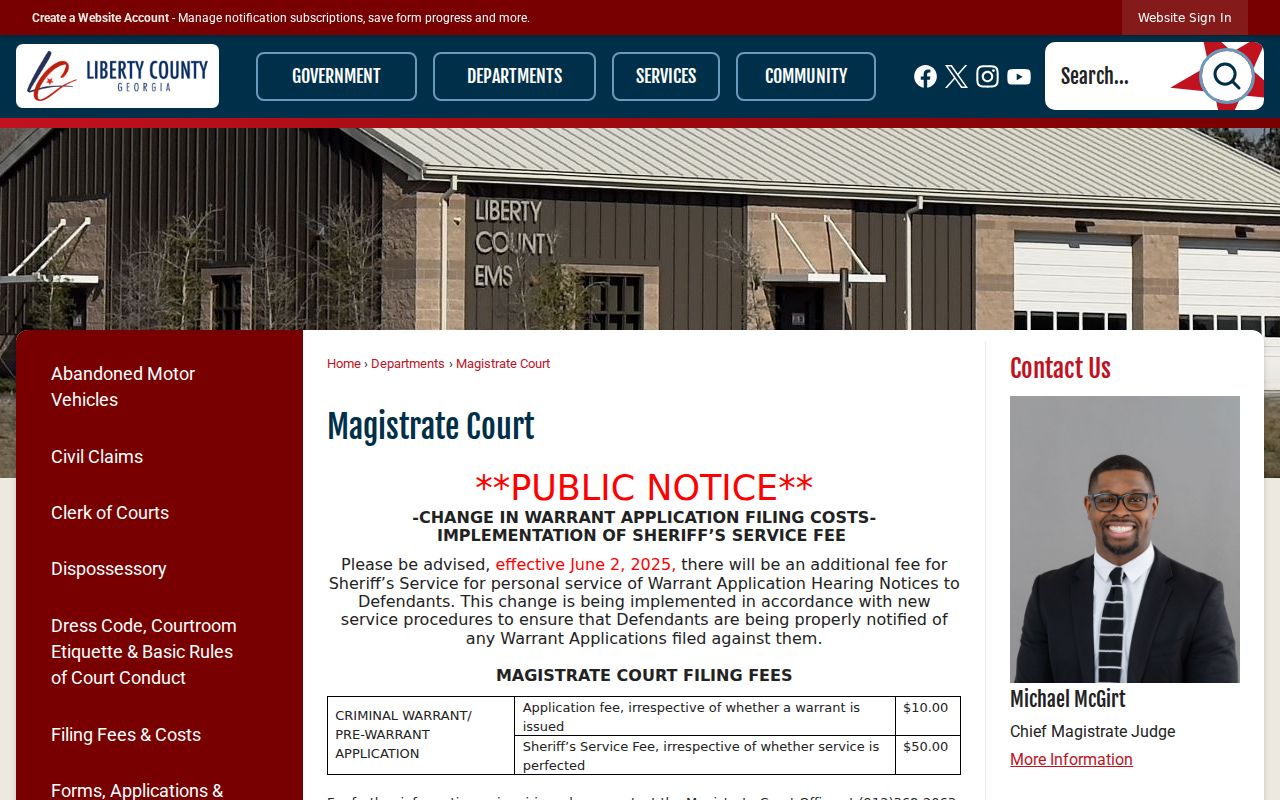
The image underscores a local quirk: warrant and bond work may occur at the Justice Center or jail, so not every criminal matter starts at the main clerk counter.
Searching Liberty County Case Records
Begin with the free Liberty Tyler CM Web Search. Its public entry page offers three confirmed paths: Search By Party, Search By Associated Party, and Search By Case Number. The clerk warns users to try every possible spelling variation. During the July 2026 research check, deeper routes looped, so no unverified subfields should be assumed.
- Open the Liberty County Tyler entry page and choose party, associated party, or case number.
- Try the exact case number first when one is known.
- For a name search, test likely spelling variants rather than treating one blank result as final.
- Read the docket sequence and identify the filed charge, latest order, and disposition.
- Ask the clerk for the specific file or certified disposition when the online view is incomplete.
| Confirmed entry path | Type | Required | Use |
|---|---|---|---|
| Search By Party | Name route | Portal determines | Start with the named defendant and spelling variants |
| Search By Associated Party | Name route | Portal determines | Locate a case through another linked party |
| Search By Case Number | Identifier route | Case number | Most direct route to a known Liberty County case |
The source image captures the Tyler gateway that supports these three confirmed routes.
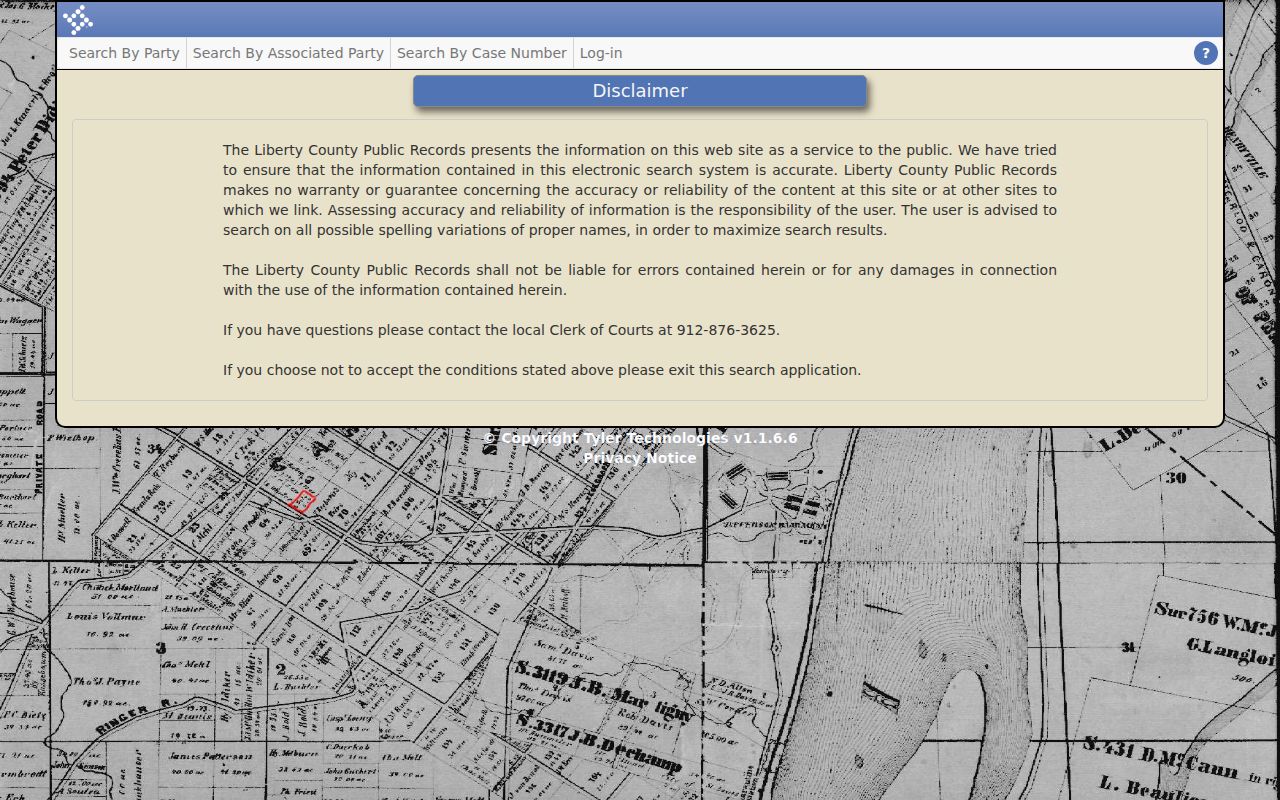
Because the deep pages were unstable during inspection, call the clerk instead of guessing at fields the public gateway did not expose.
Note: A portal disclaimer does not cancel the record; it means a certified answer must come from the Liberty County clerk.
Liberty Clerk Requires a Case
The Liberty County clerk draws a firm line between a case request and a broad criminal-history search. Staff will retrieve a specific criminal file or disposition when the requester supplies the defendant and case reference. They do not conduct a blanket history search for every matter tied to a name. Public terminals can help identify a file, but users receive only minimal search help.
Older or unindexed Liberty County criminal cases may require a counter request and paid retrieval after the first 15 minutes. Plain copies cost $1 per page. Certification costs $2.50 for the first page and $0.50 for each added certified page. Court-ordered criminal fines accept U.S. cash, cashier's check, or money order. Copies and some other clerk transactions may accept cards with the statutory surcharge, so do not treat the payment rules as interchangeable.
Liberty County Clerk of Courts
201 S. Main St., Suite 1200
Hinesville, GA 31313
912-876-3625
clerk@libertycountyga.gov
The clerk's search policy is the key source for this limit.
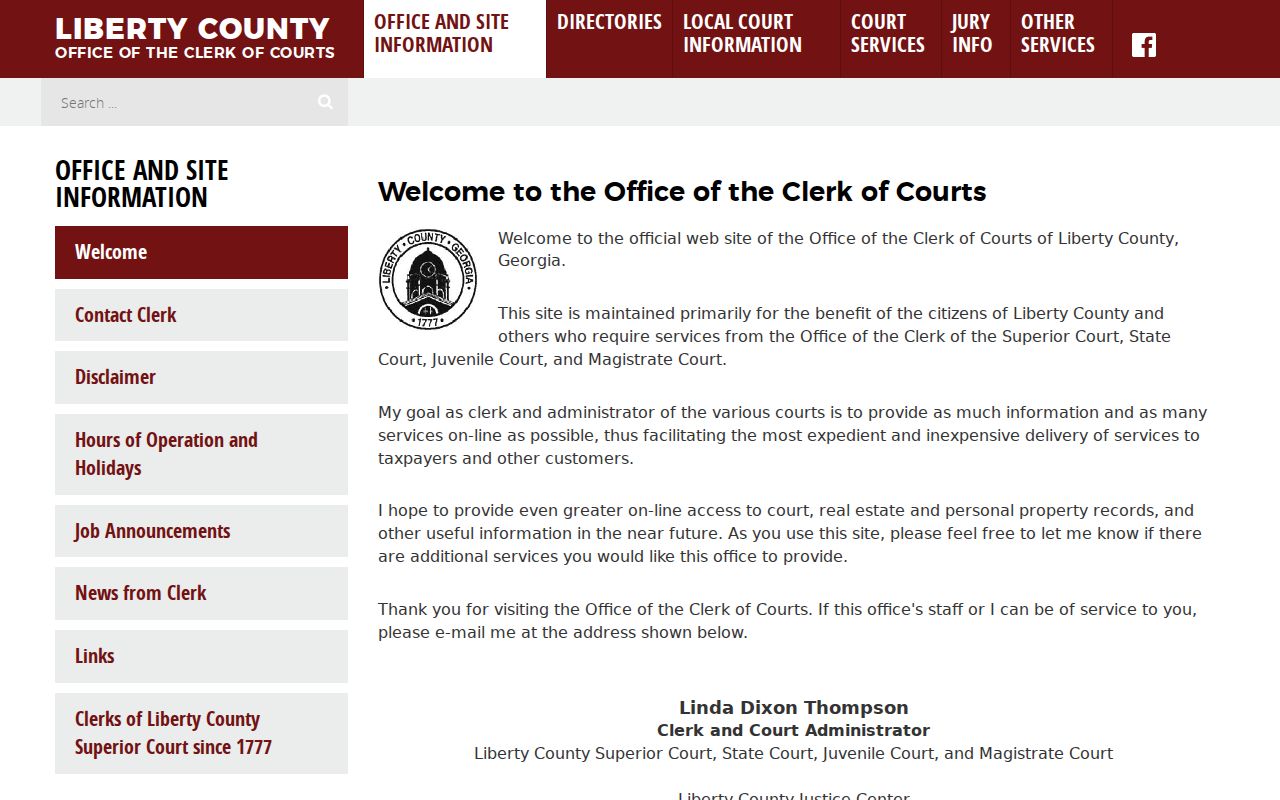
The clerk page links the local case index and gives the direct office route for a specific disposition.
Inside a Liberty County Case File
A Liberty County court file records what prosecutors filed and what the judge did. It differs from a jail booking sheet and from GCIC criminal-history data. The docket can show a charge that changed after arrest, a motion that affected the case, or a later final order that has not yet reached a statewide history.
| Case number and court | Identifies the Liberty County division and the prosecution. |
|---|---|
| Charging document | Shows an indictment, accusation, complaint, or other authorized filed charge. |
| Docket entries | Lists filed papers, hearings, orders, and procedural events. |
| Hearing dates | Shows arraignment, pretrial, plea, trial, or sentencing settings when public. |
| Disposition and judgment | States the operative result for each filed count. |
| Sentence and conditions | Records custody, probation, fines, or other court-ordered terms. |
Private identifiers, victim details, juvenile material, and information protected by an order may be withheld or redacted. A missing online document does not prove the paper file lacks it.
Reading Liberty County Case Outcomes
Georgia court terms describe different results. They should not be reduced to a simple guilty or not-guilty label. A certified disposition is the best document when the exact outcome matters.
- Disposition
- The final or operative outcome of a charge.
- Nolle prosequi
- A formal decision by the prosecutor not to continue that charge.
- Dead docket
- Removal from the active trial calendar without a final acquittal.
- No bill
- A grand jury decision not to approve an indictment.
- First Offender
- A Georgia disposition that may end in discharge and exoneration after successful completion.
These results can affect what GCIC later displays. If a statewide history lacks a disposition, review the Liberty County court file and ask the court to transmit the correction. A case dismissal also does not erase every police report or booking entry.
How a Criminal Case Moves
The Atlantic Judicial Circuit District Attorney explains that law enforcement first investigates, while the prosecutor decides whether and how to proceed. A first appearance usually addresses notice of charges, rights, counsel, bond, and the next hearing. Arrest allegations may therefore differ from an accusation, indictment, plea, or final judgment.
Liberty County case flow: Charges Filed › Arraignment › Pretrial › Plea or Trial › Disposition › Sentencing
The District Attorney's judicial-process page describes that charging role.
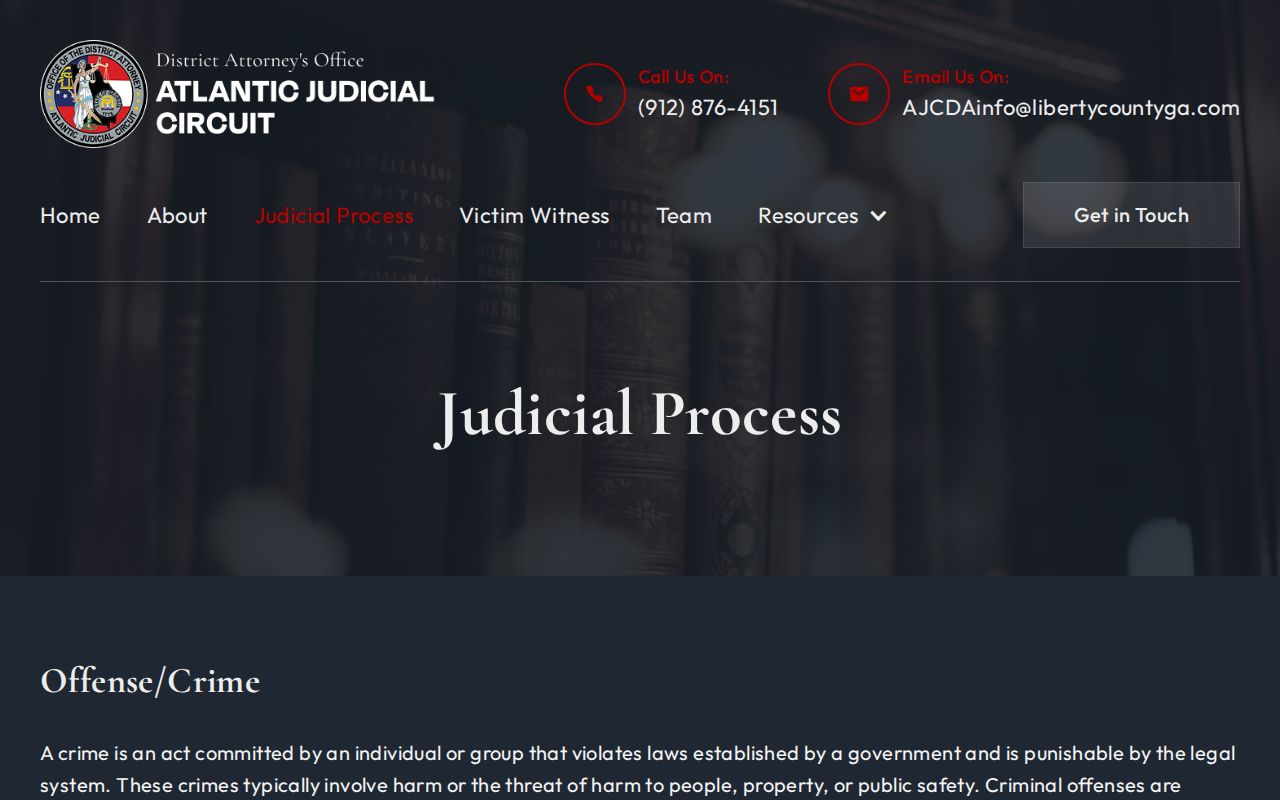
This process view explains why a booking charge should never stand in for the final Liberty County court disposition.
Liberty County Accountability Court Trails
Liberty County criminal court records can also reflect named accountability programs. The Atlantic Judicial Circuit Drug Court began in 2009. Family Treatment Court addresses substance and family issues. Veterans Treatment Court began in July 2016, and Liberty State Court runs DUI Court for repeat DUI defendants.
Veterans Treatment Court follows a 24-month, four-phase track. Its record trail can include admission, testing, treatment, judicial review, sanctions, phase changes, and completion or termination, while protected treatment details may not be public. The team includes court, prosecution, defense, Veterans Affairs, treatment, and probation representatives. The District Attorney approves charges for admission.
The county's Accountability Courts hub provides the official program overview.
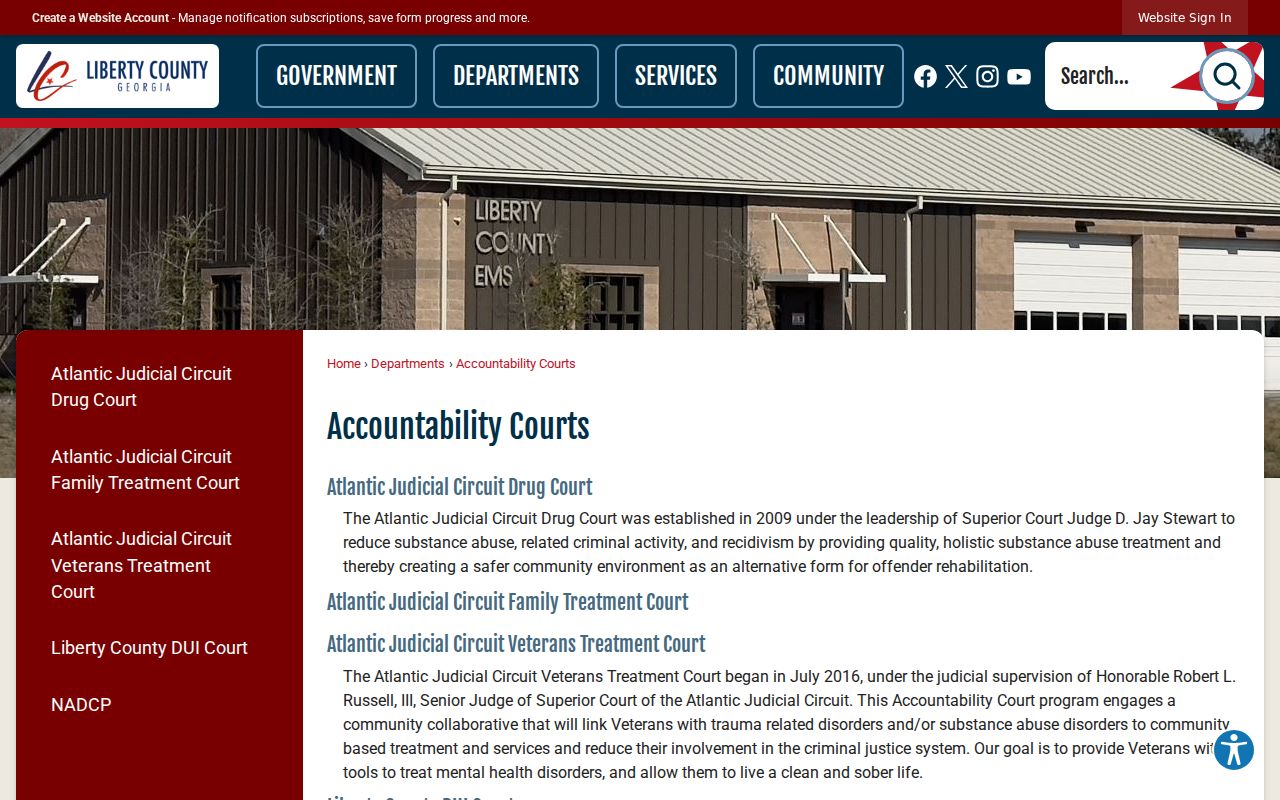
The image ties these programs to real Liberty County case milestones without suggesting that confidential treatment files are open court records.
When Liberty Tyler Links Loop
A deep-link loop or blank result calls for a fallback, not a guess. Retry from the Tyler home page, test spelling variants, and search by case number when possible. Next, call the clerk at 912-876-3625 or visit Suite 1200 for the specific case. The Justice Center counter is the proper route for an older or unindexed file.
The clerk, Sheriff, and Magistrate Court occupy separate suites in the same Justice Center. Their records remain distinct. Ask the clerk for the docket or disposition, the Sheriff for a sheriff-created report, and Magistrate Court about its warrant or bond process. This division prevents a request from landing with an office that does not hold the record.
Case Record Access & Restrictions
The Georgia Open Records Act favors prompt access, but it does not override a court order, juvenile confidentiality, protected victim data, or another specific restriction. Online views may omit documents or redact more data than the clerk's lawful paper response. Ask about the known Liberty County case rather than presuming a missing online hit means no file exists.
Georgia record restriction under O.C.G.A. §35-3-37 limits ordinary dissemination of qualifying criminal-history data. It does not promise that every court paper, agency report, or old private copy vanishes. For the status of a Liberty County prosecution, rely on its court order and certified disposition. For a statewide identity-linked record, use GCIC's official review and correction channels.
Access point: Liberty County court files, GCIC history, jail bookings, and incident reports are separate records held by separate custodians.
Note: Juvenile and sealed matters can remain unavailable even when other Liberty County criminal court records are open.